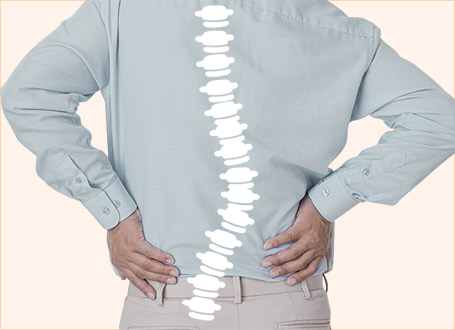

Our neurosurgery team treats a wide range of spinal conditions, including spinal stenosis and herniated discs in the neck or lower back. We also provide care for patients with cerebrovascular and other neurological conditions.
After reviewing each patient’s symptoms and test results, we recommend an appropriate treatment plan. Options range from non-surgical treatments, such as medication and injections, to surgical treatments, such as endoscopic spine surgery and artificial disc replacement.
Explore treatment options
Disc neutralization therapy
Disc neutralization therapy is a non-surgical treatment for acidic intervertebral discs (pH 7.2 or lower). Medication is injected directly into the damaged disc to help neutralize this acidity.
The treatment is designed to supply nutrients to the disc, help restore its elasticity, and relieve pain caused by mechanical stress on the disc. It is also intended to improve the flow of fluid, blood, and nutrients within the disc to support recovery.
By delivering medication directly to the damaged area, the treatment is intended to act on the disc itself, not only on the symptoms.
It may also be considered for spinal stenosis, sciatica, and chronic lower back pain.
Epidural neuroplasty
Epidural neuroplasty is a minimally invasive procedure intended to help relieve pain caused by irritated or compressed spinal nerves.
After local anesthesia, the doctor uses live X-ray imaging (C-arm fluoroscopy) to locate the affected area. A thin catheter is then inserted through an opening at the base of the spine (the sacral hiatus) and guided into the epidural space, which surrounds the spinal nerves.
A special medication is delivered directly to the damaged area through the catheter. This medication includes a local anesthetic, an enzyme, a steroid-type drug, and hypertonic saline.
The procedure is designed to reduce inflammation, swelling, and pain related to scar tissue or adhesions around the spinal nerves.
It may be considered for patients with herniated discs, spinal stenosis, or persistent nerve-related pain.
Collagen injection therapy
Collagen injection therapy involves injecting a collagen-based product into a damaged spinal disc to support its recovery.
Collagen is a natural protein found in the body. It is an important part of connective tissues, including ligaments and tendons.
The treatment may help support tissue recovery and improve pain and physical function.
Before recommending this treatment, the medical team considers the patient’s symptoms, the condition and location of the affected disc, and the type of collagen product to be used.
Endoscopic discectomy
Endoscopic discectomy is a minimally invasive spine procedure that removes disc material pressing on a nerve.
The surgeon makes a small incision, about 0.6 cm (¼ inch), and inserts an endoscope. An endoscope is a thin tube with a camera, and specialized surgical instruments are passed through it.
The camera provides a magnified view of the affected area. This allows the surgeon to remove the disc material causing nerve compression while protecting the surrounding healthy tissues.
Depending on the patient’s condition and the location of the affected disc, the procedure may be performed under local anesthesia.
The medical team reviews each patient’s overall health, age, and existing medical conditions to decide on the most appropriate surgical approach.
Endoscopic spinal fixation and fusion
This minimally invasive spinal procedure aims to reduce bleeding and tissue damage while prioritizing patient safety.
The treatment information describes its use for spinal disorders and notes that it may also be considered for older patients and those with chronic conditions.
Percutaneous nucleoplasty
This procedure reaches the disc without general anesthesia or a skin incision and aims to minimize damage to muscles, bones and nerves.
Under local anesthesia, an Arthrocare needle 0.8 mm in diameter is inserted into the disc. An electrode then uses low-temperature plasma to remove part of the disc’s inner core, or nucleus.
The aim is to relieve pressure on the nerve root and reduce the disc protrusion while preserving the outer ring, or annulus.
The treatment information lists younger patients with an intact outer disc ring (annulus), no clear degenerative changes on MRI, leg pain that is worse than back pain, and no improvement after physical therapy or exercise therapy. It also specifies that patients must have neither spinal stenosis nor spinal instability.
Microsurgical spine surgery
Microsurgical spine surgery uses a surgical microscope to give the surgeon a magnified view of the affected area of the spine.
Through a small incision, the surgeon treats disc material or other structures that are pressing on the spinal nerves.
The magnified view helps the surgeon tell the affected area apart from nearby nerves, muscles, blood vessels, and other healthy tissue.
This approach is designed to relieve pressure on the nerves while preserving as much normal tissue as possible.
It may be considered for patients with herniated discs or spinal stenosis, depending on their symptoms and imaging results.
Filum terminale sectioning
Filum terminale sectioning is a surgical procedure that cuts the filum terminale to reduce abnormal tension on the spinal cord.
The filum terminale is a thin band of fibrous tissue that extends from the lower end of the spinal cord. It helps hold the spinal cord in place inside the spinal canal.
There are two types of this surgery: internal filum terminale sectioning and external filum terminale sectioning. The surgical approach depends on the patient’s condition and examination results.
A detailed neurological evaluation is needed to decide whether the procedure is appropriate.
Lateral lumbar interbody fusion (LLIF)
Lateral lumbar interbody fusion (LLIF) is a spine surgery performed through an incision on the side of the body.
The surgeon reaches the lower spine from the side, removes the damaged disc, and places an implant between the vertebrae. The implant helps stabilize the spine and supports bone fusion, in which the vertebrae grow together into one solid unit.
Because the surgeon works from the side, this approach is designed to cause less disruption to the back muscles and surrounding tissue.
The procedure may also help restore disc height, improve spinal alignment, and create more space for the affected nerves.
The medical team decides whether LLIF is appropriate based on spinal stability, alignment, nerve compression, and the patient’s overall condition.
Artificial disc replacement
Artificial disc replacement is a surgery in which a damaged disc is removed and replaced with an artificial disc.
Spinal fusion joins neighboring vertebrae together. Artificial disc replacement is designed to preserve movement at the treated level of the spine.
The goal is to relieve symptoms caused by disc damage while maintaining spinal mobility.
To decide whether a patient is a suitable candidate, the medical team evaluates the condition of the disc, spinal stability, and the surrounding joints.
Microforaminotomy
Microforaminotomy is a minimally invasive spine procedure that relieves pressure on a spinal nerve. It does this by widening the opening where the nerve exits the spine, called the neural foramen.
The surgeon makes a small incision, about 0.5–1 cm (0.2–0.4 inch), and inserts an endoscope with a camera and specialized instruments.
Using the camera view, the surgeon selectively removes parts of the disc, ligaments, or bone that are pressing on the nerve.
The procedure is designed to relieve nerve compression while limiting damage to nearby healthy tissue.
It may be considered for patients with foraminal stenosis, which is a narrowing of the neural foramen, and related symptoms such as pain, numbness, or tingling.
Treatment suitability and results vary by patient. A medical evaluation is required.
- Spinal disorders, including herniated discs and spinal stenosis
- Stroke, cerebral hemorrhage and cerebral infarction
- Parkinson’s disease
- Alzheimer’s disease
- Disc neutralization therapy
- Epidural neuroplasty
- Collagen injection therapy
- Endoscopic discectomy
- Endoscopic spinal fusion
- Percutaneous nucleoplasty
- Microscopic spine surgery
- Filum terminale sectioning
- Lateral lumbar interbody fusion (LLIF)
- Artificial disc replacement
- Microforaminotomy